Monday, 27 June 2011

Peace Sign: The Most Awesome Symbol Ever


50 years had passed. Another 100 will pass and there is always going to be someone who is wondering what is that mark standing for. It started life as the emblem of the British anti-nuclear movement but it has become an international sign for peace, and arguably the most widely used protest symbol in the world. It has also been adapted, attacked and commercialised.Many people have speculated on just what the symbol represents; some religious zealots even claim it signifies Christ on the cross with arms broken, or a Teutonic rune representing death and despair. But the truth is not so mysterious.
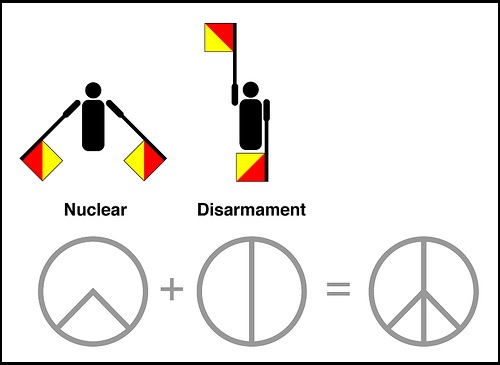
What does it mean?

One of the most widely known symbols in the world, in Britain it is recognised as standing for nuclear disarmament —and in particular as the logo of the Campaign for Nuclear Disarmament (CND). It was designed from the naval code of semaphore, and the symbol represents the code letters for ND which means Nuclear Disarmament.The circle, representing the concept of total or complete, surrounds the N and D signifying total or complete nuclear disarmament.
In the United States and much of the rest of the world it is known more broadly as the peace symbol. It was designed in 1958 by Gerald Holtom, a professional designer and artist and a graduate of the Royal College of Arts. He showed his preliminary sketches to a small group of people in the Peace News office in North London and to the Direct Action Committee Against Nuclear War, one of several smaller organisations that came together to set up CND.
The Direct Action Committee had already planned what was to be the first major anti-nuclear march, from London to Aldermaston, where British nuclear weapons were and still are manufactured. It was on that march, over the 1958 Easter weekend that the symbol first appeared in public. Five hundred cardboard lollipops on sticks were produced. Half were black on white and half white on green. Just as the church’s liturgical colours change over Easter, so the colours were to change, “from Winter to Spring, from Death to Life.” Black and white would be displayed on Good Friday and Saturday, green and white on Easter Sunday and Monday.
The first badges were made by Eric Austin of Kensington CND using white clay with the symbol painted black. Again there was a conscious symbolism. They were distributed with a note explaining that in the event of a nuclear war, these fired pottery badges would be among the few human artifacts to survive the nuclear inferno. These early ceramic badges can still be found and one, lent by CND, was included in the Imperial War Museum’s 1999/2000 exhibition ”From the Bomb to the Beatles”.
Later, in a letter, Holtom also admitted that the symbol reflected his mood at the time. “I was in despair,” he wrote. “Deep despair. I drew myself: the representative of an individual in despair, with hands palm outstretched outwards and downwards in the manner of Goya’s peasant before the firing squad. I formalized the drawing into a line and put a circle around it.”
American journalist and playwright Herb Greer adds support for the Holtom explanation. He reported, “I was actually there on and before the first Aldermaston march for which it was created. I visited Holtom, I saw the original sketches and discussed it with him.”
Ken Kolsbun, author of the book Peace: The Biography of a Symbol, reported that Holtom expressed regret in not designing the peace symbol with the joyful lifting of arms towards the sky. For most of Holtom’s life he would draw only the upright peace symbol. Holtom requested that the upright peace symbol be placed on his tombstone in Kent, England. If we take a look on  the picture of his tombstone, we’ll see that  his wish was unfortunately ignored.
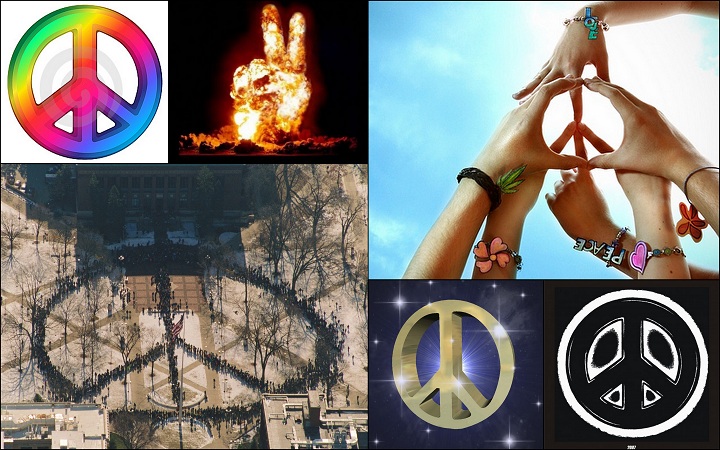
While it appears reasonable that the modern day peace symbol comes from Gerald Holtom, this logic fails to address the fact that the symbol has been used for evil both in modern times and for thousands of years.
This same symbol was used by Hitler’s 3rd Panzer Division from 1941 to 1945.  The image on the left is the regimental 3rd Panzer Division symbol. Soviet, Polish, and Hungarian citizens, having suffered from the Nazi massacres, undoubtedly struggled with Holtom’s use of the symbol as a thoughtful way to communicate peace. The symbol can also be found on some of Hitler’s SS soldiers’ tombstones.
Another flaw in the Holtom creation story is the use of the symbol as an anti-Christian symbol by the Saracens as early as 711 A.D.For the Saracens, the image placed on their shields symbolized the breaking of the Christian cross. For some the broken cross was equated to a satanic symbol known as the raven’s craw or witch’s foot. While Holtom may not have known the historical meaning of the peace symbol, Bertrand Russell was a historian and member of the Fabian Society. A 1970 article in the American Opinion magazine claimed Russell knew the historical occult meaning and intentionally selected an “anti-Christian design long associated with Satanism.”
The fifth and final Roman emperor of the Julio-Claudian dynasty, Nero (born Lucius Domitius Ahenabarbus 37 – 68 AD), is remembered in history for persecuting Christians. Nero’s rule was so wicked he even had his mother executed. The First Roman-Jewish War (66 – 70 AD) started during his reign and today the term “Nero Cross” is the symbol of the “broken Jew” or “broken cross.” The most famous person believed to be crucified by Nero was the Apostle Peter. To symbolize humility and unworthiness in comparison to Christ, Peter requested that he be crucified with his head toward the ground. As a result of Peter’s death the upside down cross was used by early Christians as a positive symbol for peace.

The symbol of the upside down cross changes its meaning when the person on the upside down cross is no longer Peter but Jesus. Anti-religious and satanic groups use the “Nero Cross” or inverted “Latin Cross” to symbolize everything opposite of Christianity. Today this is clearly illustrated by “black metal” or heavy metal music lyrics and imagery that communicate anti-Christian sentiments.  In addition to musicians, film makers have reinforced the notion that the upside down cross is an anti-Christian symbol as illustrated by The Omen in 1976 and The Exorcism of Emily Rose in 2005.
The symbol has also been used to communicate support for communism. Bertrand Russell once said: “There is no hope in anything but the Soviet way.” Governments–both those who supported communism and those opposed to it–have perceived benefits in aligning the peace symbol with communist ideology. For people like Bertrand Russell, the author of the 1927 essay Why I Am Not Christian, the symbol represented not only a pro-communism meaning but peace without God.

CND has never registered the sign as a trademark, arguing that “a symbol of freedom, it is free for all”. It has now appeared on millions of mugs, T-shirts, rings and nose-studs. Bizarrely, it has also made an appearance on packets of Lucky Strike cigarettes.A decade ago, the sign was chosen during a public vote to appear on a US commemorative postage stamp saluting the 1960s.The symbol that helped define a generation of baby boomers may not be as widely used today as in the past. It is in danger of becoming to many people a retro fashion item, although the Iraq war has seen it re-emerge with something like its original purpose.
“It is still the dominant peace sign,” argues Lawrence Wittner, an expert on peace movements at the University at Albany in New York.”Part of that is down to its simplicity. It can be used as a shorthand for many causes because it can be reproduced really quickly – on walls on floors, which is important, in say, repressive societies.”
And can its success be measured? Fifty years on, wars have continued to be waged and the list of nuclear-armed states has steadily lengthened.But the cup is half-full as well as half empty.
“There are many ways in which nuclear war has been prevented,” says Mr Wittner. “The hawks say that the reason nuclear weapons have not been used is because of the deterrent. But I believe popular pressure has restrained powers from using them and helped curbed the arms race.And the symbol of and inspiration for that popular pressure, says Mr Wittner, is Mr Holtom’s graphic.
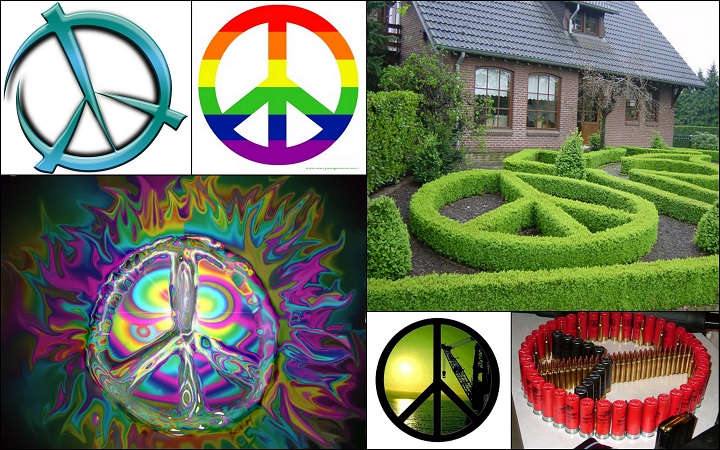
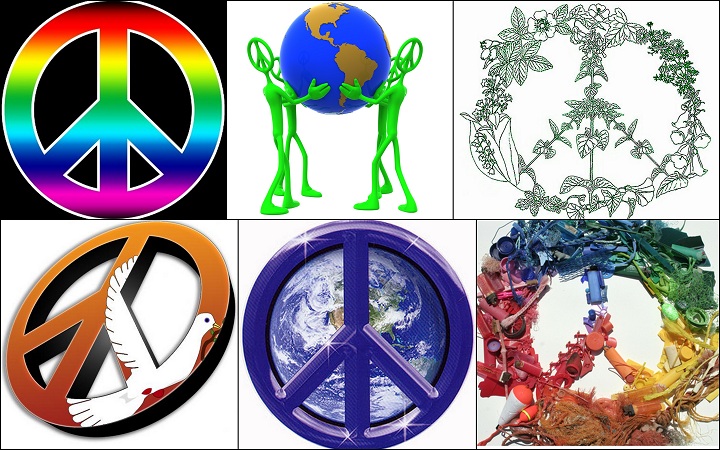
“Today because many people carry the symbol without understanding the history, we miss an opportunity to address historical uses and move forward to reclaim the symbol for good.When you see the peace symbol, I encourage you to see the person displaying it as communicating a message of love.If you display the peace symbol, my recommendation is point the arms of the peace symbol toward the sky to honor Holtom’s wish, address historical objections, and communicate love of all people.”Dave Dionisi, Teach Peace Foundation

Information and images sources : 1 2 3 4 5 6

30+ Absolutely Stunningly Beautiful Nature


Like most designers, I am constantly looking at the nature around me, and I am constantly in awe at its stunning beauty. One of the places I go to get inspiration is in nature, because of its amazing color spectrum, textures, and depth. The most amazing thing about nature is being about to capture these amazing nature moments on camera. Today’s round-up features absolutely stunningly beautiful nature photography shots for your inspiration! I hope you find them as inspirational as I have!! All of these amazing Photographs contain links back to their original sources, so please click on the images if you would like to see more! Enjoy!

Angel by João Pedro Soares

Aquila chrysaetos by Henrik Just

Bat by jimmy hoffman

The Color Carpet by mm767cap

Campaign speech by liangdawei

harmony by Shlomi Nissim

New Tricot by Jens G

Rose Ringed Parakeet by nissim

Purpose by Dzagoda

Female Rubythroated Hummingbird by John Minelli

Vipera berus by Thord Brant

Green tree python by Jesper Larsen

Sea Eagle in sunset by Tommy Solberg

Blue Morning by barbara

I will give you a splash! by Mikael Jigmo

Hypnotic seeds by Jörg Hubrich

Troll stories by Johan Stomberg

Mirror mirror by Leif Westling

Lonely tree by Tomasz Trzebiatowski

A caterpillar by Yvan Barbier

Larakeet by Brian McIntosh

Penguins in ice by Stefan Lindén

Eclipse by Lennart Kuijs

Too Close by Oren Cohen

Jacks by Stefan Beskow

Surrounded by Norbert Probst

Nature Landscape by Hải

Hidden Paradise by Ping Chen

Krajinka by strakus

Taal volcano by Alex

Puffin by Dave

Mountain Reflected in Sea by hanvic

Antelope Canyon by Romain Guy

Organ volcanic by Eric VOLTO

The Racetrack by Bryan Brazil

Amphiprion ocellaris by Pedro GoniO

We offer best quality pass4sure mcse test papers and citrix certificationmaterials. You can get our 100% guaranteed EX0-101 questions &testking 70-432 to help you in passing the real exam of ccip.

world's best waterfalls


Here is the collection of some extremely beautiful photos of waterfalls. Enjoy.

Victoria Falls

Great and Beautiful Waterfalls
In the world of great waterfalls the grand Victoria Falls of South Africa has truly stolen away the lime light from the last many years. It has been one of the major tourist attractions of South Africa. People just love to view the exotic and spectacular natural beauty of these great falls. Most of the tourists from all across the world enjoy their vacations with their family members in the lapse of these huge water curtains. The great Victoria Falls of South Africa are one of the Seven Wonders of the World today. These great waterfalls are located on the Zambezi River which lies in the Southern Africa. The grand Zambezi River lies between the two countries of South Africa and they are Zambia and Zimbabwe. These great waterfalls are also known as “Mosi-Oa-Tunya” by the local residents of South Africa which literally means the Smoke of the Thunders. The chilled water of the great Victoria Falls from a height of 1200 meters which make this water fall one of the highest waterfalls of the world.

Iguazu Falls

Great and Beautiful Waterfalls
In the world of ostentatious and majestic waterfalls of the world, the great Iguazu Falls have stolen away the glare of publicity. The great Iguazu Falls have been the major tourist attractions from the last many years. These giant water curtains are cited in the lapse of the grand Iguazu River which is located on the frame of the Brazilian State and the Argentine prefecture. These grand and glorious waterfalls divide up the Iguazu River into two parts: one part is the upper Iguazu and the other part is the lower Iguazu. These gigantic waterfalls are one of the major tourist’s attractions for the visitors as well as the local residents of Brazil and Argentina. These mammoth waterfalls are comprised up with entire natural beauty and splendor. These waterfalls mainly separate two major countries and they are Brazil and Argentina. These giant water curtains are taller than the famous Niagara Falls and they are as wide as 275 cascades. For the duration of the rainy season in between November and April, the water level of these falls tremendously increases and adds enough charm to its gorgeousness and attractiveness.

Huangguoshu, China

Great and Beautiful Waterfalls
Also known as Yellow Fruit Tree Waterfall, Haungguoshu waterfall is one of the largest plunge in Asia. Witnessing this cascading water, its mightiness can be only first thing one can think of. Positioned on Baihe River, Huangguoshu is around 77.8 meters high and about 101 meters wide. Hundred of thousands of people visit this place every year. Besides the Great Wall, this is undoubtedly the best attraction in China.

Blue Nile Falls, Ethiopia

Great and Beautiful Waterfalls
This waterfall is also christened as Tis Issat, which means smoking water. Along with being a major tourist attraction, Blue Nile Falls is extensively used generate power in the area. More and more people are visiting this place, providing Ethiopia a great tourist income. It is located on Blue Nile River and is probably the best spot to visit, when in Ethiopia.

Angel Falls, Venezuela

Great and Beautiful Waterfalls
Feel the peak of mightiness at Angel Falls, where huge mass of water plummets beautifully from the height of 978 meters, making it the highest waterfalls of the world. The source of this fall is the pinnacle of Auyan Tepuy, a mountain from where the water plunges without any interruption. However, more interesting than the fall is the entrance. This fall can be accessed from Canaima National Park, the only gateway to Angel Falls, and is reached by air. Witnessing all these falls in a lifetime is an ecstasy rarely gained. However, visit to any one also promises remarkable gratification.

Niagara Falls, Canada/USA

Great and Beautiful Waterfalls
With more than 14 million visitors every year, Niagara Falls is probably the most admired waterfall around the world. This magnificent plunge shares its beauty with two countries and is a combination of three falls. The Bridal Veil Falls and American Falls can be witnessed from New York City. And the glorious panorama of Horseshoe Falls can be viewed from Canada. Due to the natural vista around the falls, this destination has attracted various tourist businesses like hotels, adventures, and tour packages.

Jog Falls, India

Great and Beautiful Waterfalls
Gushing over River Sharavathi, Jog Falls is considered to be the largest waterfall in India. The plunge is around 829 feet high, which is roughly 253 meters. To witness the most splendid views of Jog Falls, it’s advisable to visit this destination in monsoon season, as very little water can be seen in arid days. However, during monsoon, this plunge exceeds the volume and height of Kaiteus Falls.

Gullfoss, Iceland

Great and Beautiful Waterfalls
Also known as ‘the Golden Falls’, Gullfoss waterfall is a remarkable double cascade with an altitude of 32 meter, perfectly positioned on White River. This destination is considered to be one of the most popular tourist places in Europe mainly because of the panorama it creates in summer days. During arid season, the glacial runoff and rainwater makes its way through this waterfall and runs into the White River. It is probably the best attraction in Iceland.

Dettifoss Water Falls

Great and Beautiful Waterfalls
Dettifoss is 44m tall and 100m wide. The stream is so powerful and you can hear the roar from distance if you visit Jökulsárgljúfur National Park, Iceland. The waterfalls transfers 500 cubic meters of waters per second from Vatnajökull glacier down to the sea. You can snap beautiful objects from the two different side of the waterfalls.

Sutherland Falls

Great and Beautiful Waterfalls
The waterfalls is located in Fiorland National Park, New Zeland. It is famous for the rough stream, beautiful scenery, and the Milford Track. Loads of people know that this tack is one of the finest track in the world.

Kaieteur Falls

Great and Beautiful Waterfalls
If you have enough money, you can go to Kaieteur falls in Postaro river, Guyana. Because the transportation is poor, not so many people know about this beautiful object. The Kaieteur Falls drops 221m and spreads 100m from one side to the others. The current is so strong so that the power is often matched with Iguazu falls, Niagara falls and Victoria falls.

Yosemite Falls

Great and Beautiful Waterfalls
The waterfalls is known as one of the tallest in the world and it stands 2425ft from the lower course. Yosemite Falls is the eye of Yosemite national park and if you come in a right time, you can get this waterfall flowing its hard and rough stream from the cliff.

Angel Falls

Great and Beautiful Waterfalls
Angel falls plunging 979m down and it is known as the tallest waterfalls on earth. Local people named this place as Auyantepuy (Devil’s Mountain). This waterfalls hides many histories and stories. You can see this place at the rain forest of Canaima National Park, Venezuela.

Plitvice Waterfalls

Great and Beautiful Waterfalls
Plitvice Waterfalls is renowned since the late of 19th century. Plitvice Waterfalls offers the beauty of 2 lakes and green areas around it on this area, you can find a 70m tall waterfalls and beautiful Boardwalks. If you like to visit Plitvice Waterfalls, you should go to Northern Dalmatia. It is located at 2-hour drive south Zagreb, the capital city of Croatia actually.

Great Falls

Great and Beautiful Waterfalls
Great Falls, also known as Grindstone Falls, has a height of 10m or 33 feet, and a crest width of 5m or 16 feet. It is located on the Grindstone Creek in Waterdown section of Hamilton just off Mill Street, and has year round flow. A viewing platform has been built beside the waterfall as well as a parking lot. This area, known as Smokey Hollow, was once heavily industrial, as the Grindstone Creek was a power source for a sawmill at the base of Great Falls, as well as other mills that appeared over the years. By 1912, however, the mills had all closed, as the water level in Grindstone Creek had gone down and the steam engines that propelled the waterpower were acknowledged to be too dangerous. Today, thanks to a rehabilitation program implemented by Waterdown residents, the locality is a beautiful and well-kept park.

Damajagua Falls

Great and Beautiful Waterfalls
This inspiring activity for nature lovers takes you beyond the gold-sand beaches of Puerto Plata and into the silver-capped mountains for the 27 waterfalls of Damajagua, a fairytale-like labyrinth of tunnels and caves set against a backdrop of rural mountain scenery. Trek through jungle and scale rock mounds as high as 40 feet before cascading into crystal-clear natural swimming pools. The most intrepid explorers hike the hour required to reach the highest waterfall before descending a three-hour-long track. A shorter but no less challenging trail scrambles up and down the first seven falls with plenty of swimming breaks in between.

Kegon Falls. Japan

Great and Beautiful Waterfalls
It IS one of Japan’s three great waterfalls, taking water from the nearby Lake Chuzenji down 318 feet off the edge of a cliff to a river below. You can took an elevator down to an observation deck for a spectacular view.It is usually shrouded in fog and mist. To the side of the falls is an impressive display of cobalt rock formations.